
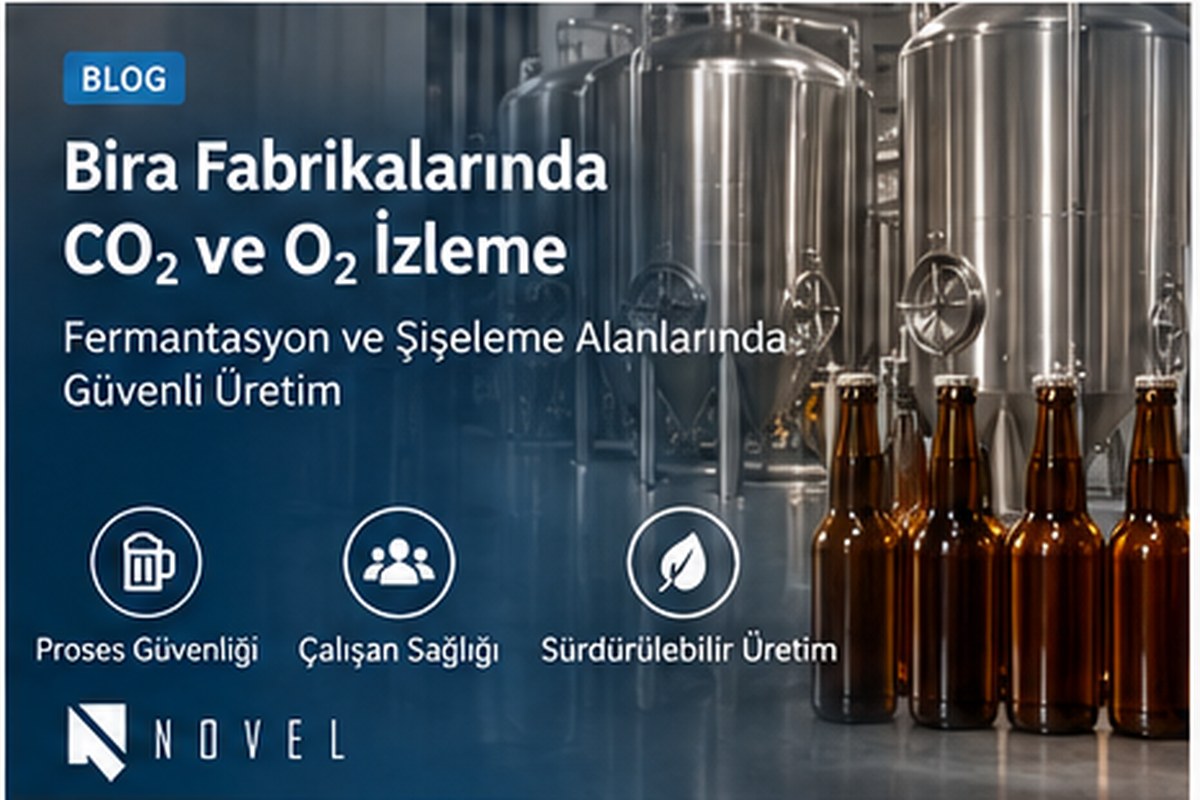
In brewing, fermentation generates CO₂; CO₂ can also be utilised during bottling operations. The reference CETCI application note addresses simultaneous continuous monitoring of CO₂ and O₂ in both the fermentation room and bottling lines. Atmospheric verification prior to vessel/tank cleaning is an especially critical requirement.
For process safety, evaluating CO₂ sensors alongside O₂ sensors therefore provides a robust technical methodology.
CO₂ Hazards in Beer Fermentation
The source documentation states that substantial quantities of CO₂ are generated during fermentation, which may be vented or recovered depending on process design. Escaping CO₂ can pool in low-lying areas, dilute ambient oxygen, and, being odourless and colourless, go undetected without active instrumentation.
Atmospheric Verification Prior to Vat and Tank Cleaning
The source specifically highlights the necessity of verifying CO₂ levels before personnel enter vats/tanks for cleaning. Such entries must also be managed under confined space entry protocols in accordance with the facility's prevailing safety procedures.
O₂ + CO₂ Monitoring in the Fermentation Room
The LPT-A-O₂ transmitter is installed in the breathing zone at approximately 4–6 ft above floor level, in proximity to the tanks. The specified measuring range for O₂ is 0–25% vol . The AST-IS18 NDIR CO₂ transmitter is utilised with a specified range of 0–4% vol.
Why is the Bottling Line Monitored Separately?
The source documentation indicates that bottles may be pre-flushed with CO₂ prior to filling, recommending dedicated O₂ and CO₂ transmitters in the bottling hall as well.
Monitoring Up to Four Channels with the QCC
The reference notes that the QCC accommodates up to four analogue/digital transmitter inputs. This enables, for example, two fermentation sensors plus two bottling line sensors to be consolidated into a single control architecture. Alarm relays can actuate ventilation systems and remote audible/visual sounders.
Brewery Gas Monitoring Points
| Area | Monitored parameter | Rationale |
|---|---|---|
| Fermentation tanks | CO₂ + O₂ | Fermentation off-gas and oxygen depletion |
| Vat/tank entry | CO₂/O₂ atmospheric verification | Safety prior to cleaning entry |
| Bottling line | CO₂ + O₂ | Localised risk from CO₂ pre-filling |
| Room entrance | Controller / remote display | Status verification prior to entry |
| Internal area | Strobe / horn | Visual and audible site alarm notification |
Which CO2 and O2 Detectors Should be Chosen for a Brewery?
In a brewery environment, infrared sensors for CO₂, electrochemical sensors for oxygen, and a central controller should be evaluated together. NOVEL supports configuring fixed gas detection solutions for fermentation, bottling, and confined vessel entry based on sensor count, mounting location, alarm thresholds, and ventilation integration. View Fixed Gas Detectors.
Let Us Select the Right Gas Detector for Your Application Together
Share your target gas, expected concentration, area layout, and automation requirements. The NOVEL Technical Team will conduct a technical assessment for sensor type, installation location, and system architecture.
Frequently Asked Questions
Why can CO2 present a hazard in beer fermentation?
Fugitive CO₂ can pool in low-lying areas and displace oxygen; the gas is odourless and colourless.
Is measuring CO2 alone sufficient in a brewery?
The reference application recommends monitoring O₂ concurrently with CO₂, as oxygen depletion constitutes a critical risk.
Is gas testing required before tank cleaning?
The source documentation specifically stresses verifying CO₂ concentrations prior to entering vats or tanks.
Why is a CO2 sensor needed on the bottling line?
The reference notes that purging bottles with CO₂ prior to filling introduces a separate, localised CO₂ hazard within the bottling area.
What technology is used in the CO2 sensor?
The source specifies a non-dispersive infrared (NDIR) CO₂ sensor for the AST-IS18.
Can fermentation and bottling be connected to the same QCC?
The source indicates that the QCC accepts up to four transmitter inputs; specific channel count and signal interfaces must be verified for each project.
Reference and Technical Note
The application architecture and model-specific technical details in this article have been compiled from an application document provided by Critical Environment Technologies Canada Inc. . As source materials may be superseded, current product codes, certificates, measuring ranges, and local regulations must be independently verified prior to project design or procurement.
Author: NOVEL Technical Team
Publication date: 7 September 2026