
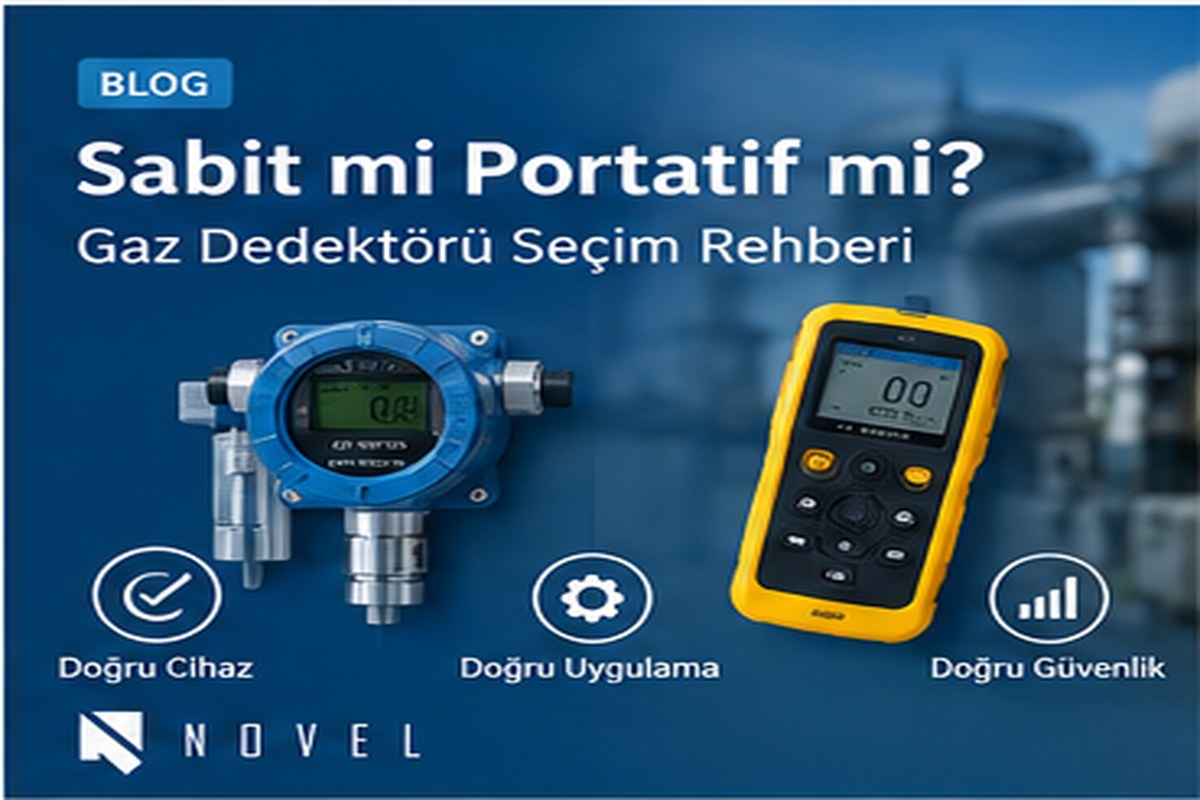
Although fixed gas detection systems and portable gas monitors may appear to be alternatives to each other, the core message of the source CETCI technical note is different: the two technologies serve different risk scenarios and, when used together in many facilities, establish a stronger safety layer.
Area dimensions, whether the gas hazard is persistent or transient, personnel mobility, confined space entries, and automation requirements are decisive factors in system selection.
What Is a Fixed Gas Detection System?
Fixed systems consist of sensors/transmitters and controllers permanently mounted at designated locations. According to the reference document, they are suitable for continuous monitoring across large work areas, facilities with high personnel occupancy, and strategic locations where gas accumulation is anticipated.
A significant distinction of fixed systems is their ability to trigger automated safety functions—such as fan operation, equipment shutdown, or remote alarm signalling—via alarm relays, analogue/digital outputs, and connectivity to building/process automation.
What Is a Portable Gas Monitor?
A portable device moves with the worker. It offers flexibility for small spaces, confined space entries, maintenance work, transient risks, and investigating leak locations. However, the instrument must be switched on, charged, fitted with the appropriate sensors, and the user must be properly trained.
Comparison of Fixed and Portable Systems
| Criterion | Fixed system | Portable monitor |
|---|---|---|
| Monitoring profile | Continuous, at fixed locations | When the instrument is switched on and carried by personnel |
| Area type | Large area / critical fixed locations | Confined space / maintenance / mobile personnel |
| Automation | Available via relays, 4–20 mA, digital communications | Generally focused on user notification |
| Sensor placement | Strategic placement at levels where gas accumulates | Dependent on the carried position of the worker |
| Bump test approach | A periodic schedule is emphasised in the source note | Pre-use testing is emphasised more frequently in the source note |
| Physical durability | Fixed, can be protected with protective enclosures | Higher risk of impact/wear due to being carried |
Why a Portable Instrument Alone Is Not Always Sufficient
The reference document notes that a portable monitor follows the breathing zone height of the worker. However, heavy gases may accumulate near the floor, whilst light gases collect near the ceiling. A fixed sensor can be installed at the correct elevation based on the physical behaviour of the gas.
On the other hand, a fixed system does not always represent the personal exposure of a worker entering an enclosed volume such as a tank or sewer. At this point, a portable device becomes critical.
Combined Use: The Most Robust Scenario
Two examples stand out in the source note: in a leak where the fixed system issues the primary alarm, locating the leak point using a portable instrument fitted with a probe; additionally, continuously monitoring the general plant area with a fixed system whilst inspecting a rarely entered, confined section using a portable instrument.
7-Question Checklist for Selection
- Is the risk continuous or transient?
- How large is the area?
- Are personnel stationary or mobile?
- Where does the gas accumulate?
- Is automated action required, such as fans/valves/isolation switches?
- Are there confined space entries?
- What happens to the safety layer if a single instrument fails?
How to Select Fixed and Portable Gas Detectors at NOVEL?
The NOVEL portfolio includes fixed gas detectors, portable multi-gas detectors, refrigerant leak detectors, and dedicated detection solutions tailored for diverse processes. Proper selection must be determined based on target gas, measuring range, ATEX requirements, continuous alarm/automation needs, and personnel operational workflows. View Gas Detector Products.
Let Us Select the Right Gas Detector for Your Application Together
Share your target gas, expected concentration, area layout, and automation requirements. The NOVEL Technical Team will conduct a technical assessment for sensor type, installation location, and system architecture.
Technical Support / Request a QuoteView Gas Detector Products
Frequently Asked Questions
Can a fixed gas detector replace a portable device?
Not in every situation. While a fixed system monitors the general area continuously, a portable device moves with the worker and is required for transient scenarios such as confined spaces and maintenance.
Can a portable gas detector be used in place of a fixed system?
It can be used in small or temporary areas; however, in large facilities with continuous monitoring and automation requirements, relying solely on portable instruments may prove impractical.
Which has a longer sensor life?
The reference document states that some fixed sensors may exhibit a longer operating life due to their larger physical footprint; actual lifespan depends on sensor technology, gas exposure, and environmental conditions.
Which instruments require a bump test?
Functional verification is vital for both fixed and portable systems. The reference document emphasises a pre-use bump test approach for portable devices, and scheduled periodic testing for fixed systems.
Which is more suitable for locating leaks?
A fixed system can generate alarms and identify the hazardous zone; a portable instrument is far more versatile for pinpointing the leak location using a probe.
Is using both together the safest approach?
In many facilities, yes. The fixed system provides continuous area monitoring, while the portable instrument delivers an individual/mobile safety layer; however, the final architecture should be established based on a risk assessment.
Reference and Technical Note
The application architecture and model-specific technical details in this article have been compiled from an application document provided by Critical Environment Technologies Canada Inc. . As source materials may be superseded, current product codes, certificates, measuring ranges, and local regulations must be independently verified prior to project design or procurement.
Author: NOVEL Technical Team
Publication date: 7 September 2026