
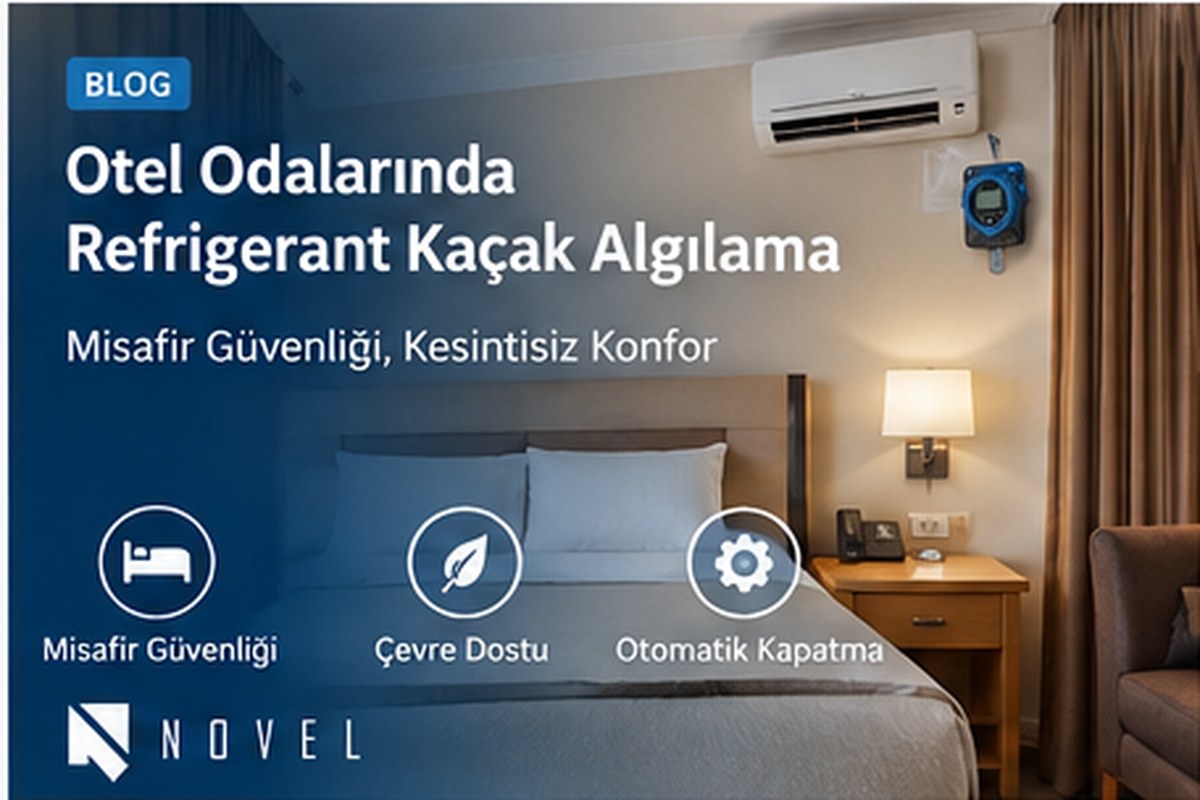
Air conditioning units in hotel rooms can leak refrigerant gas due to continuous operation, inadequate maintenance, or mechanical failure. The source CETCI application note describes a continuous monitoring approach using a remote refrigerant sensor positioned close to the AC coil in each room and a visible LPT-A transmitter in the room.
This facilitates both service access and measurement representative of the actual leak location.
Why Is Refrigerant Leakage Monitored in Hotel Rooms?
The source document states that wear and tear, incorrect operation, or inadequate maintenance in air conditioning units can lead to refrigerant leaks. Early detection helps reduce human exposure, environmental impact, refrigerant loss, and potential additional costs in air conditioning equipment.
Where Is the Remote Sensor Located?
The remote solid-state refrigerant sensor is placed close to the air conditioning coil area. The LPT-A transmitter can be positioned at a height convenient for viewing and maintenance within the room. The source specifies a maximum cable distance of 50 ft (15 m) between the transmitter and the sensor.
Source Sensor Specifications
In the source document, a range of 0–2,000 ppm and a 5-year sensor life are specified for the remote refrigerant sensor. This information pertains to the relevant source configuration; current model/refrigerant compatibility must be verified prior to ordering.
Can the Air Conditioning Be Shut Down Automatically on Leak Detection?
A dry contact relay is provided on the LPT-A and can be used in the source application to shut down the air conditioning under alarm conditions. Furthermore, measurement or alarm data can be transferred to a central controller/BAS via a 4–20 mA or 0–10 V output.
Is a Sensor Required in Every Room?
The source document illustrates an LPT-A + remote sensor approach for continuous leak monitoring in every room equipped with air conditioning. An actual project must be evaluated from an engineering standpoint within the scope of refrigerant charge volume, room volume, equipment type, and prevailing standards/regulations.
LPT-A Source Specifications
| Specification | Information provided in source |
|---|---|
| Display | Switchable LCD |
| Alarm | Internal audible alarm |
| Relay | 30 V @ 2 A dry contact |
| Analogue output | 4–20 mA or 0–10 V |
| Power supply | 3-wire VDC or 4-wire VAC |
| Enclosure | Water/dust resistant, corrosion resistant |
| Compliance | CSA, UL, CE, FCC designations appear in the source document |
Which Refrigerant Leak Detector Should Be Selected for Hotel Rooms?
In a hotel project, the air conditioning type in each room and the refrigerant used must be verified. Products in NOVEL's refrigerant gas detectors category can be evaluated according to the target refrigerant and measurement objective. In room-based systems, a remote sensor, local relay for AC shutdown, and alarm transmission to central building automation are key selection criteria. View Refrigerant Gas Detectors.
Let Us Select the Right Gas Detector for Your Application Together
Share your target gas, expected concentration, area layout, and automation requirements. The NOVEL Technical Team will conduct a technical assessment for sensor type, installation location, and system architecture.
Technical Support / Request a QuoteView Refrigerant Gas Detectors
Frequently Asked Questions
How is an air conditioning gas leak detected in a hotel room?
The source system uses a remote refrigerant sensor close to the AC coil area and an LPT-A transmitter inside the room.
What is the permissible distance between the sensor and the transmitter?
According to the source document, a maximum cable distance of 50 ft, approximately 15 m, is recommended.
Can the air conditioning shut down automatically when a leak occurs?
Yes. The source states that the dry contact relay on the LPT-A can be used to shut down the air conditioning on alarm.
Can data be sent to a BAS system?
The source specifies controller/BAS communication via 4–20 mA or 0–10 V output for the LPT-A.
Can gases other than R410A be measured?
The source file discusses an example with an SR410A sensor. Sensor compatibility for different refrigerants must be verified separately.
Is a separate sensor required in every hotel room?
The source application illustrates a dedicated monitoring approach for each room with air conditioning; final requirements are determined based on room volume, refrigerant, and project standards.
Reference and Technical Note
The application architecture and model-specific technical details in this article have been compiled from an application document provided by Critical Environment Technologies Canada Inc. . As source materials may be superseded, current product codes, certificates, measuring ranges, and local regulations must be independently verified prior to project design or procurement.
Author: NOVEL Technical Team
Publication date: 7 September 2026