
NOVEL · Product and System Solutions
New Cosmos SDM-72 / SDM-73 – Robotic Bearing Wear and Iron Powder in Oil Measuring Instruments
Iron wear particle analysis in grease and oil samples • Predictive maintenance and robotic reducer monitoring
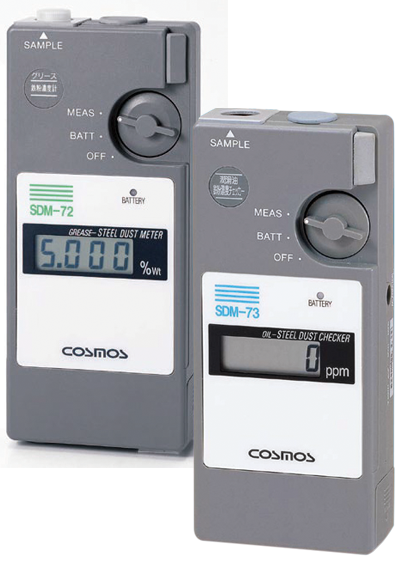
New Cosmos SDM-72 / SDM-73
Predictive Maintenance Solution for Bearings, Robotic Reducers and Rotating Equipment
Do not monitor bearing wear solely by noise and vibration. The New Cosmos SDM series supports predictive maintenance decisions by measuring the concentration of iron wear particles in grease or oil in the field within approximately 2–3 seconds. It is a powerful complementary method for tracking early wear trends, particularly in low-speed and variable-speed equipment.
Used to regularly compare iron dust changes in the lubricating medium in industrial robots, bearing housings, reducers, pumps and other rotating equipment.
Product Features
- SDM-72 measures iron wear particles in grease samples, and SDM-73 in oil samples, displaying them in units appropriate to the model.
- Results can be obtained in the field in approximately 2–3 seconds using the magnetic balance electromagnetic induction method.
- Small sample requirement: approximately 0.8 mL grease for SDM-72; 1.5 mL oil for SDM-73.
- Provides maintenance teams with trend data through repeated sample tracking in robot joints, bearing housings, gearboxes and reducers.
- A measurement approach complementing vibration and temperature monitoring in low-speed and variable-speed equipment.
Product Videos
Watch Video ↗
Technical Specifications
Technical Table 1
| SDM-72 (Measurement of steel dust concentration in grease samples) | SDM-73 (Measurement of steel dust concentration in oil samples) |
|---|---|
| Measures steel/metal wear dust in waste/discharged grease as %Wt . | Measures steel/metal wear dust in oil as ppm (Wt) . |
| Measurement starts automatically upon inserting the sample cup; the reading is completed in approximately 2–3 seconds . | Measurement starts automatically upon inserting the syringe+holder; approximately 2–3 seconds . |
| Sample volume: ~0.8 mL | Sample volume: 1.5 mL |
New Cosmos SDM-72 – Grease Iron Dust Meter
| Detection Principle | Magnetic Balance Electromagnetic Induction Method |
|---|---|
| Detected Substance | Steel Dust in Grease Oil |
| Detection Range | 0–5.000 % (Wt) |
| Resolution | 0.001 %Wt |
| Verification/Calibration | Features automatic zero adjustment for regular verification. Manufacturer calibration at least once a year is strongly recommended. |
| Required Sample Volume | ~0.8ml |
| Battery Specifications and Life | ~30 hours with 4 x AA Alkaline Batteries |
| Weight | ~500 g (Including Batteries) |
| Standard Accessories | Carrying Case, Sampling Spatula, Sampling Tubes (10 Pieces), 4xAA Alkaline Batteries |
New Cosmos SDM-73 – Oil Iron Dust Meter
| Detection Principle | Magnetic Balance Type Electromagnetic Induction Method |
|---|---|
| Detected Substance | Steel Dust in Machine Oil |
| Detection Range | 0–19,999 ppm (Wt) |
| Resolution | 1 Wt ppm |
| Verification/Calibration | Features automatic zero adjustment for regular verification. Manufacturer calibration at least once a year is strongly recommended. |
| Required Sample Volume | 1.5ml |
| Battery Specifications and Life | ~30 hours with 4 x AA Alkaline Batteries |
| Weight | ~500 g (Including Batteries) |
| Standard Accessories | Carrying Case, 2ml Syringes (2 Pieces), Syringe Holder, Sampling Tubes (2 Pieces), 4xAA Alkaline Batteries |
Field sampling and rapid measurement – 3 steps
| SDM-72 (Grease) | SDM-73 (Oil) |
|---|---|
| Switch to MEAS mode, verify the value on the display is 0.000 . | Switch to MEAS mode, verify the value on the display is 0.000 . |
| Fill the sample cup with grease (0.8 mL groove) and insert with the grease surface facing upwards . | Draw the oil sample into the syringe, insert together with the syringe+holder . |
| After a 2–3 s beep, the value is held on the display; record it. The instrument automatically zeroes when the cup is removed. | After a 2–3 s beep, the value is held on the display; record it. When removing, remove the syringe+holder together. |
Technical Table 5
| Level | Value | Recommended Action |
|---|---|---|
| Normal | < 0.05% | Monitoring at normal intervals |
| Caution | 0.05 – 0.1% | Re-greasing + re-measurement after 1 month |
| Abnormal | > 0.1% | Lubrication improvement + monitoring at short intervals / detailed diagnosis |
Technical Table 6
| Level | Large Machine | Small Machine |
|---|---|---|
| Normal | < 30 ppm | < 100 ppm |
| Caution | 30 – 100 ppm | 100 – 300 ppm |
| Abnormal | > 100 ppm | > 300 ppm |
Sample monitoring frequencies according to machine operating conditions
| Machine Type | Measurement Cycle (Sample) |
|---|---|
| Low speed – Normal temperature | 3 – 6 months |
| Medium / High speed – Normal temperature | 3 – 6 months |
| Low speed – High temperature | 1 – 4 months |
The intervals here are examples only; the facility risk assessment, manufacturer maintenance plan and measurement history are primary.
Model Selection: Grease or Oil?
The primary criterion for model selection is the sample type: SDM-72 is preferred for grease-lubricated mechanisms, and SDM-73 for oil-lubricated mechanisms. Model selection information from the existing product page has been retained in the table below.
Application Areas and Advantages in Predictive Maintenance
Why iron dust measurement?
Metallic wear particles detaching from bearing and gear surfaces accumulate within grease or oil. Monitoring the iron dust trend can trigger maintenance inspection before vibration levels rise significantly.
- Measurement results can be obtained in approximately 2–3 seconds.
- Helps reduce the likelihood of unplanned downtime via trend tracking.
- Facilitates the review of lubrication and maintenance intervals.
- Sampling and reading procedures can be performed by field service teams.
In which facilities and machines?
- Industrial robot joints and reducers
- Bearing housings, gearboxes and conveyors
- Motors, pumps and fans
- Lifts, cranes and transmission systems
- Wind turbines and other rotating equipment
The method complementsvibration and temperature analysis alongside maintenance records; it does not constitute definitive mechanical fault diagnosis on its own.
Measurement principle and which metals is it sensitive to?
The magnetic balance type electromagnetic induction method detects changes caused by ferromagnetic iron-bearing wear particles in the sample. Substances exhibiting magnetic properties, primarily iron as well as nickel and cobalt, can influence the measurement signal; the instrument does not report these separately as elemental analysis.
Non-ferromagnetic metal particles such as aluminium, copper and lead are not measured in the same manner by this method. In certain oxide/rust types, the signal may be affected; results should be evaluated in conjunction with sample conditions.
Manufacturer Sample Reference Criteria and Measurement Intervals
The manufacturer sample approach involves reviewing lubrication and re-measuring after approximately one month at the caution level, and shorter monitoring intervals with detailed inspection at the abnormal level.
Frequently Asked Questions About New Cosmos SDM-72 / SDM-73
What is the difference between SDM-72 and SDM-73?
SDM-72 measures iron wear dust concentration in grease samples as weight percentage (% Wt). SDM-73 measures concentration in oil samples as weight ppm (Wt). Sampling apparatus and measurement ranges also differ.
In what range does SDM-72 measure?
New Cosmos SDM-72 measures iron dust concentration in grease within the 0–5.000 % (Wt) range, with a resolution of 0.001 % (Wt). Approximately 0.8 mL of grease sample is required.
In what range does SDM-73 measure?
New Cosmos SDM-73 measures iron wear dust in oil within the 0–19,999 ppm (Wt) range, with a resolution of 1 ppm (Wt). Approximately 1.5 mL of oil sample is used.
Why is the SDM series used in robotic bearing and reducer maintenance?
In low-speed or variable-speed machinery, vibration measurement alone may not indicate early wear symptoms. Periodic tracking of iron dust in grease/oil supports wear trend monitoring and maintenance planning; it is not a definitive fault diagnosis on its own.
Do SDM-72 and SDM-73 replace vibration analysis?
No. Iron wear particle measurement should be interpreted together with vibration, temperature, oil analysis, operating history and the equipment manufacturer's maintenance criteria. The objective of the measurement is to provide complementary condition monitoring data.
Can the normal and warning thresholds in the manufacturer brochure be applied to every machine?
No. The manufacturer's sample criteria tables serve as general guidance. Facility-specific limits must be established taking into account grease/oil type, filtration, sampling location, equipment size and historical measurement trends.
Do the instruments detect non-ferrous metal wear?
The measurement principle is based on magnetic balance type electromagnetic induction and focuses on iron-containing ferromagnetic particles. It is not designed to determine the total concentration of non-ferromagnetic metals such as aluminium and copper.
How does NOVEL assist with instrument selection, training and calibration?
NOVEL can provide technical support regarding SDM-72/SDM-73 model selection according to the lubricating medium, correct sampling workflows, user training and manufacturer documentation. Calibration/service scope and current CE documentation must be confirmed separately upon request.
Application Areas
Related Solutions and Product Family
NOVEL technical support
For your application,
let us select the right solution together.
Request a Quote from NOVEL ↗A draft opens in your email client with the subject header of the relevant product or category.