NOVEL · Product and System Solutions

New Cosmos KS-7 Series

Fixed Gas Detectors

New Cosmos KS-7 series fixed gas detector

Fixed Gas Detectors with Display and Internal Alarm for Monitoring Oxygen, Carbon Monoxide and Carbon Dioxide

Request a Quote from NOVEL ↗

Detectable Gases

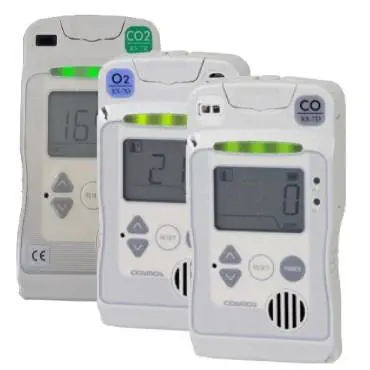
KS-7O measures oxygen and KS-7D carbon monoxide; these are separate models. Select KS-7R for CO₂.


The New Cosmos KS-7 series; selected according to the target gas KS-7O oxygen (O2), KS-7D carbon monoxide (CO) and KS-7R carbon dioxide (CO2) is a compact, fixed diffusion-type gas detection family consisting of models for specific gases. Each model is designed for a single target gas. Featuring a large LCD display, built-in audible and visual alarm, compact enclosure and external system connection options, it can be used for continuous gas safety monitoring in cleanrooms, laboratories, manufacturing areas, plant rooms, enclosed workspaces and similar non-ATEX applications.

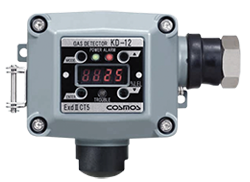
Important: The KS-7 series is not explosion-proof. In Zone 0, Zone 1 or Zone 2 hazardous areas, an Ex/ATEX certified fixed gas detector suitable for the application must be selected. See KD-12 ATEX Fixed Gas Detector
Product Specifications
  • Single-Point Fixed Gas Monitoring: Sensor and alarm unit are housed within the same compact enclosure; depending on the target gas, O2, CO or CO2 model is selected.
  • Large LCD Display: Backlit digital display facilitating direct on-site monitoring of gas concentration.
  • Audible and Visual Alarm: Local warning via LED indicators at alarm levels and an audible alarm of at least 70 dB/1 m.
  • 4-20 mA and Relay Integration: Connectivity to PLC, BMS, automation or external alarm systems via gas concentration analogue signal and alarm contacts.
  • Optional Battery Backup: With the optional battery unit on KS-7O and KS-7D models, backup operation of up to approximately 350 hours can be provided during power outages. During battery/backup operation, certain external output functions may behave differently compared to AC/DC mains supply.
  • Compact and Lightweight Design: Designed for wall-mounted fixed installation with an enclosure measuring approximately W82 × H150 × D35 mm and a weight of approximately 0.3 kg.
  • Made in Japan: Developed by New Cosmos Electric Co., Ltd. for industrial gas detection applications.

Which KS-7 Model Should You Select?

Nitrogen Leak and Oxygen Deficiency Monitoring

Monitoring oxygen depletion instead of measuring nitrogen directly: N2, Ar and similar inert gases can dilute the proportion of oxygen in ambient air to hazardous levels when dispersed in an enclosed space. In such applications, the aim is often not to measure the inert gas concentration directly, but to rapidly and continuously detect when O2 levels in the workspace drop below safe thresholds. KS-7O is the appropriate fixed model for this purpose. Final device quantity and mounting locations must be determined based on room volume, gas source, potential leak points, ventilation layout, gas dispersion behaviour and site risk assessment.

Primary Application Areas

Laboratories and R&DContinuous ambient monitoring in workspaces using gas cylinders, inert gas lines and CO₂.
Cleanrooms and Production AreasControlled indoor environments with oxygen deficiency, CO or CO₂ risks.
Plant RoomsEquipment and gas distribution spaces containing nitrogen, argon, CO₂ or combustion processes.
Food and BeverageProcesses using CO₂, storage areas and surrounds of gas cylinders/manifolds.
Industrial PlantsFixed-point applications with risk of CO generation or inert-gas-induced O₂ depletion.
Healthcare and ResearchTechnical areas using gas, research laboratories and support facilities.
Product Brochures
Product Instruction Manual - Manual
Technical Specifications

KS-7O

KS-7O Technical Specifications

Detected GasOxygen (O2)
Sensor / Detection PrincipleGalvanic cell sensor
Sampling MethodDiffusion type
Measurement Range0-25.0 vol% or 0-50.0 vol%
DisplayBacklit LCD; 0.1 vol% resolution
Alarm ValuesF.S. 25.0 vol%: AL1 19.0 vol%, AL2 18.0 vol%
F.S. 50.0 vol%: AL1 18.0 vol% low alarm, AL2 25.0 vol% high alarm
Alarm setpoints are adjustable in accordance with manufacturer documentation.
Indication Accuracy25.0 vol% and below: ±0.7 vol%
25.1 vol% and above: ±3.0 vol%
Alarm DelayCriterion of reaching 18.0 vol% within 5 seconds under test conditions at 20±2°C
Connection OutputsDC 4-20 mA gas concentration analogue output; 1st and 2nd stage gas alarm relay contacts and fault contact
Power SupplyDC 24 V ±10% or AC 100 V ±10%, 50/60 Hz; optional battery unit
Optional Backup OperationUp to approx. 350 hours with optional battery. During battery/backup operation, external output behaviour may differ from standard AC/DC operation.
Operating Temperature / Humidity-10…+40°C / 30…85% RH, non-condensing and without sudden changes
Dimensions / WeightW82 × H150 × D35 mm (excluding projections) / approx. 0.3 kg
Explosion ProtectionNot Ex-proof / ATEX; must not be installed in hazardous areas.
Country of ManufactureJapan
KS-7O application note: Particularly in enclosed spaces where nitrogen, argon or similar inert gases are used, it can be chosen to continuously monitor the depletion of ambient oxygen rather than the inert gas itself. Sensor location and device quantity must be determined based on site risk assessment.
KS-7D

KS-7D Technical Specifications

Detected GasCarbon monoxide (CO)
Sensor / Detection PrincipleElectrochemical sensor
Sampling MethodDiffusion type
Measurement Range0-75 ppm, 0-150 ppm, 0-250 ppm or 0-400 ppm
DisplayBacklit 4-digit LCD; 1 ppm resolution
Alarm Values0-75 ppm: 25 / 50 ppm
0-150 ppm: 50 / 100 ppm
0-250 ppm: 50 / 150 ppm
0-400 ppm: 50 / 150 ppm
Alarm DelayAlarm activation within 60 seconds under manufacturer test gas conditions
Connection OutputsDC 4-20 mA gas concentration analogue output; 1st and 2nd stage gas alarm relay contacts
Power SupplyDC 24 V ±10% or AC 100 V ±10%, 50/60 Hz; optional battery unit
Optional Backup OperationUp to approx. 350 hours with optional battery. During battery/backup operation, certain external output functions differ from standard power supply.
Operating Temperature / Humidity-5…+40°C / 30…85% RH, non-condensing and without sudden changes
Dimensions / WeightW82 × H150 × D35 mm (excluding projections) / approx. 0.3 kg
Country of ManufactureJapan
KS-7R

KS-7R Technical Specifications

Detected GasCarbon Dioxide (CO2)
Sensor / Detection PrincipleNDIR (non-dispersive infrared)
Sampling MethodDiffusion type
Measurement Range0-5000 ppm; minimum detectable concentration 360 ppm
DisplayBacklit 4-digit LCD; 5 ppm resolution
Alarm ValuesAL1: 2000 ppm
AL2: 5000 ppm
Indication Accuracy0…+40°C: ±5% F.S.; ±10% F.S. at specified operating temperatures outside this range (in the 360-5000 ppm range)
Response TimeT50: 50 s, T60: 60 s, T90: 90 s
Connection OutputsDC 4-20 mA analogue output; 1st and 2nd stage gas alarm contacts and fault contact
Power SupplyDC 24 V ±10%
Operating Temperature / Humidity-10…+50°C / 0…85% RH, non-condensing and without sudden changes
Dimensions / WeightW82 × H150 × D35 mm / approx. 300 g
ComplianceEMC / CE
Country of ManufactureJapan
KS-7R measurement note: The manufacturer lists 360 ppm as the minimum detectable concentration and prohibits use below 360 ppm in CO2 atmospheres. The 5000 ppm value is the second alarm setpoint for this model; it must not be interpreted as a general “World Health Organization limit”.

Gas Detection and Standards Approach

Gas detection approach: Target gas, measurement range, alarm purpose, diffusion/sampling method, sensor principle, hazardous area classification, ventilation and mounting location must be evaluated together. In project evaluation, EN 50104 for oxygen applications, the EN 45544 series for toxic gas applications and the EN/IEC 60079 series for explosive atmospheres may be relevant. These references do not imply that the KS-7 series is certified to all standards; exact compliance must be confirmed based on model, target gas, application area and current certification documentation.

Points to Consider for Installation and System Design

Gas SourceThe location of the cylinder, manifold, process line, equipment or combustion source is the starting point of the installation plan.
VentilationMechanical and natural air currents can alter the direction of gas accumulation and dispersion.
Detector QuantityA single instrument may not be sufficient for every site; area volume, partitions and risk locations must be assessed together.
Alarm ScenarioIt must be determined whether local audible/visual alarms alone are required, or connections to sounders, beacons, PLC, BMS or a central panel.
Hazardous Area ClassificationThe KS-7 series is not Ex-proof. A certified alternative product must be selected for ATEX/Ex areas.
Maintenance and CalibrationThe gas detection system must be operated in accordance with the manufacturer's maintenance and periodic inspection instructions.

Sectors

Frequently Asked Questions

Does the KS-7 series measure O₂, CO and CO₂ simultaneously?
No. The series contains dedicated models according to the target gas: KS-7O is for oxygen, KS-7D is for carbon monoxide and KS-7R is for carbon dioxide. If multiple gas hazards exist on a site, the required models are evaluated individually.
Which model is used to monitor oxygen depletion in a nitrogen leak?
If the intention is to monitor the decrease of oxygen in ambient air rather than measuring nitrogen directly, KS-7O is the appropriate model. The number of devices and mounting locations must be determined according to room volume, gas source, leak scenario and ventilation conditions.
Is the KS-7 series suitable for ATEX or explosive atmospheres?
No. The KS-7 series is not explosion-proof. In zoned areas, an Ex/ATEX certified fixed gas detector suitable for the application must be selected.
Can the KS-7O and KS-7D operate during a power outage?
Backup operation for up to approximately 350 hours is possible with the optional battery unit. However, during battery operation or automatic backup, certain functions such as the analogue output and alarm contacts may behave differently compared to standard AC/DC supply mode.
Can KS-7 devices be connected to a PLC or central alarm system?
Yes. Depending on model configuration, integration with PLCs, BMS, central alarm panels, sirens or similar supervisory systems can be established via 4-20 mA analogue gas concentration outputs and alarm relay contacts.
Does NOVEL provide support for product selection and system design?
Yes. Technical support is provided regarding suitable models and system architecture by evaluating gas type, target measurement range, area classification, ambient conditions, alarm requirements and supervisory system connections.

Alternative and Complementary Products

Depending on application conditions, hazardous area classification or central control requirements, the following solutions may also be considered.

Notice: The technical information, product specifications and images on this page have been prepared based on sources published by the manufacturer. The manufacturer reserves the right to make modifications to product specifications and technical data without prior notice. To verify current product specifications before purchasing or to obtain technical support in determining the most suitable product and solution for your application, info@novel.com.tr you can contact NOVEL at

NOVEL technical support

For your application,
let us select the right solution together.

Request a Quote from NOVEL ↗

A draft opens in your email client with the subject header of the relevant product or category.