Compare safety systems that help transmit lone worker SOS calls, man-down (fall/immobility) alarms and location data to authorised teams. NOVEL offers Blackline Safety G7c, TWIG One, TWIG Neo, and ATEX/IECEx-certified TWIG Neo-Ex and TWIG One-Ex options for explosive atmospheres across organised industrial zones (OIZ), urban gas distribution, energy and industrial maintenance applications.
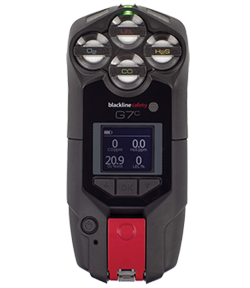
Blackline Safety G7c - Lone Worker Safety, 4G Tracking and Gas Detection
Operation and technical details
Current product description
Blackline Safety G7c is an advanced safety and communication device developed to enhance lone worker safety, combining real-time tracking, emergency alarming and multi-gas detection with interchangeable sensor cartridges in a single housing. In areas with cellular coverage, it connects to the Blackline Live system to support alarm monitoring and emergency response. It provides an ambitious solution for professional field teams that accelerates the measurement process and reinforces operational safety and utilisation efficiency.
Where is it used?
Supports remote monitoring of incident location and alarm nature for OIZ maintenance teams, urban gas distribution services, energy utilities and mobile field personnel.
Key features
Connects to the Blackline Live system via 4G cellular networks. Offers configuration-dependent SOS, check-in, man-down, two-way communication and interchangeable single/multi-gas sensor cartridge options.
Considerations for model selection
Important distinction: G7c does not feature direct satellite connectivity. For remote areas without cellular coverage, the G7x + G7 Bridge satellite connectivity architecture should be evaluated separately.
Blackline Safety G7c links personnel safety to a central monitoring system with cellular connectivity, SOS alarms, fall/immobility notifications, location tracking and selectable gas detection cartridges.
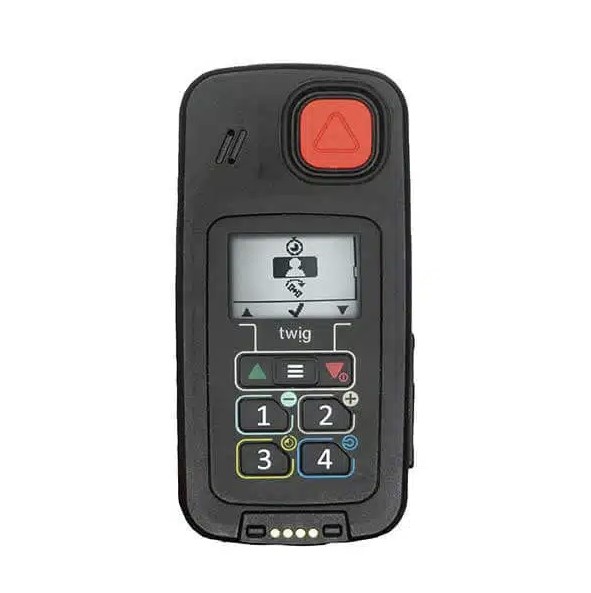
TWIG One – Industrial Lone Worker SOS and Man-Down Alarm Device
Operation and technical details
Product description and model family
TWIG One and TWIG One-Ex are personal alarm devices optimised for lone workers, providing safety in noisy and hazardous industrial environments. With their powerful loudspeaker, robust design, programmable keys, expandable functions and straightforward integration features, they are an ideal choice for industrial requirements. They offer an ambitious solution for professional field teams that accelerates the measurement process and reinforces operational safety and utilisation efficiency.
Where is it used?
Voice communication in noisy environments and an easily accessible emergency button are essential for industrial facilities, energy infrastructure, construction sites and field maintenance teams.
Key features
Supports 4G mobile communication, SOS calling, man-down alarm, Wi-Fi/Bluetooth/SRD-based indoor positioning on compatible hardware, and alarm monitoring integration with TWIG Point.
Considerations for model selection
For explosive atmospheres, the TWIG One-Ex option must be selected by verifying relevant ATEX/IECEx certification; standard TWIG One and One-Ex must not be assumed to have the same certification scope.
TWIG One is a rugged personal alarm device designed for noisy industrial and field conditions. It combines SOS, immobility/fall alarms, 4G communication and GNSS location tracking.
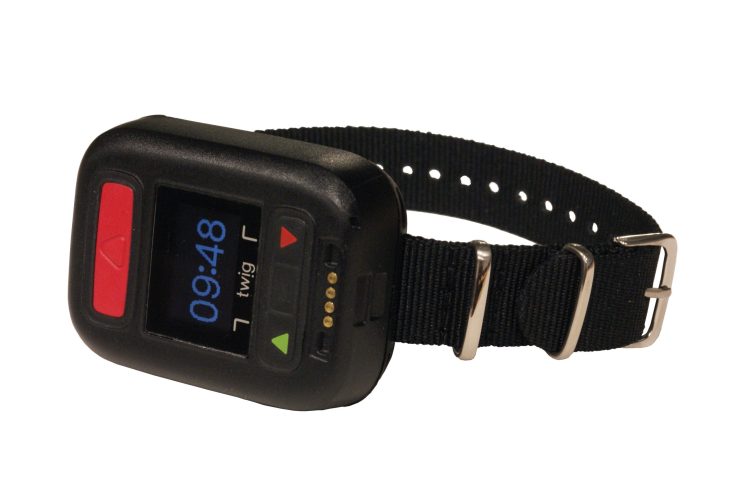
TWIG Neo - Compact Wearable Lone Worker Location and SOS Alarm
Operation and technical details
Current product description
The TWIG Neo model provides functionality similar to its powerful sibling, the One model, but in a significantly more portable form factor designed to be worn comfortably on the operative. These devices facilitate lone worker communication in emergencies, identify individual locations and enable liaison with personnel to direct emergency response teams. They offer an ambitious solution for professional field teams that accelerates the measurement process and reinforces operational safety and utilisation efficiency.
Where is it used?
Aimed at the portable alarm requirements of technical service, hospital, laboratory, logistics, facilities management, security patrol and mobile maintenance personnel.
Key features
Open-field location via GNSS; indoor location support via Wi-Fi, Bluetooth beacons or SRD with suitable hardware and infrastructure, as well as SOS and man-down notifications can be provided.
Considerations for model selection
In areas requiring ATEX, the TWIG Neo-Ex model—whose certification status must be verified for the specific application—should be considered instead of the standard TWIG Neo. Identical physical ruggedness, battery capacity and key layout to the One must not be assumed.
TWIG Neo is a lightweight, compact wearable personnel safety device focused on SOS alarms, location sharing and remote monitoring for lone worker safety.
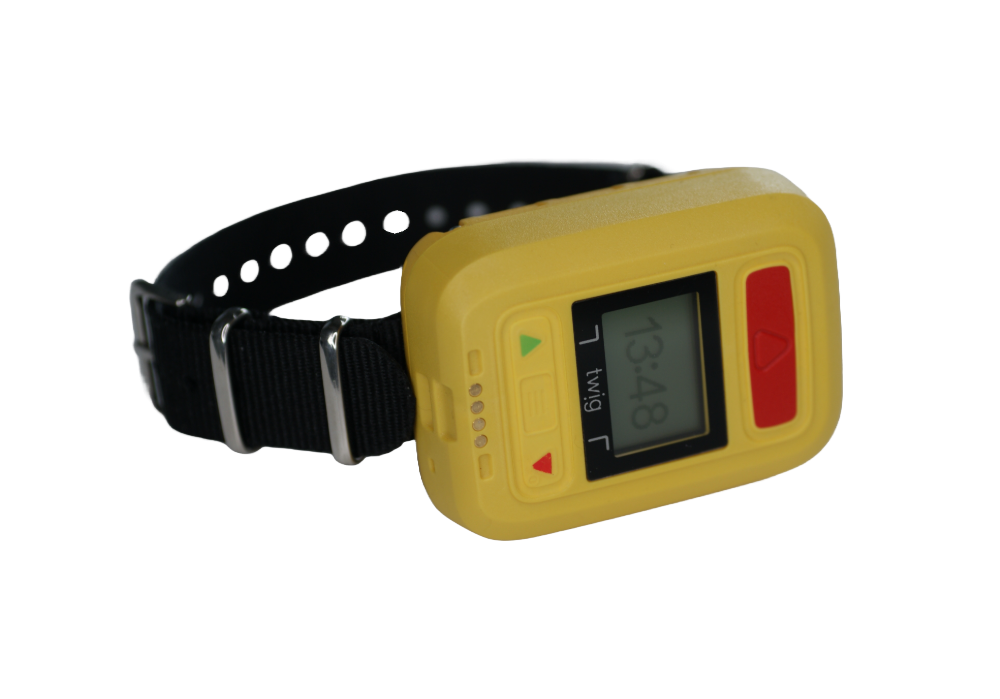
TWIG Neo-Ex – ATEX/IECEx-Certified Compact Lone Worker Alarm Device
Operation and technical details
Where is it used?
Evaluated for maintenance and service personnel working alone in explosive atmospheres across OIZ natural gas infrastructure, oil and gas operations, chemical, pharmaceutical and process industries who require a lightweight alarm device.
Key safety features
Configuration-dependent SOS, fall and immobility (man-down) alerts, communication over 4G, open-field location via GNSS, indoor location support via Wi-Fi/Bluetooth and TWIG Point / MPTP integration. Features various carrying options including wristband, clip and lanyard.
ATEX / IECEx scope
Manufacturer-published marking: II 2 G Ex ib IIC T4 Gb and II 2 D Ex ib IIIB T130°C Db. Certified operating ambient temperature −20°C to +50°C; protection rating IP67. The manufacturer datasheet specifies EESF 24 ATEX 022X / IECEx EESF 24.0016X.
Considerations for model selection
The dust group for Neo-Ex is IIIB, which is not identical to IIIC on the One-Ex model. Zone classification, gas/dust group, permissible temperature and certified Ex accessories/charging equipment must be checked prior to commencing work. This device is not a detector that measures gas concentrations.
TWIG Neo-Ex is a compact, wrist-wearable ATEX/IECEx-approved SOS and man-down alarm for mobile personnel working in facilities with explosive gas or dust atmospheres. Provides 4G communication, GNSS and, with appropriate infrastructure, indoor location support.
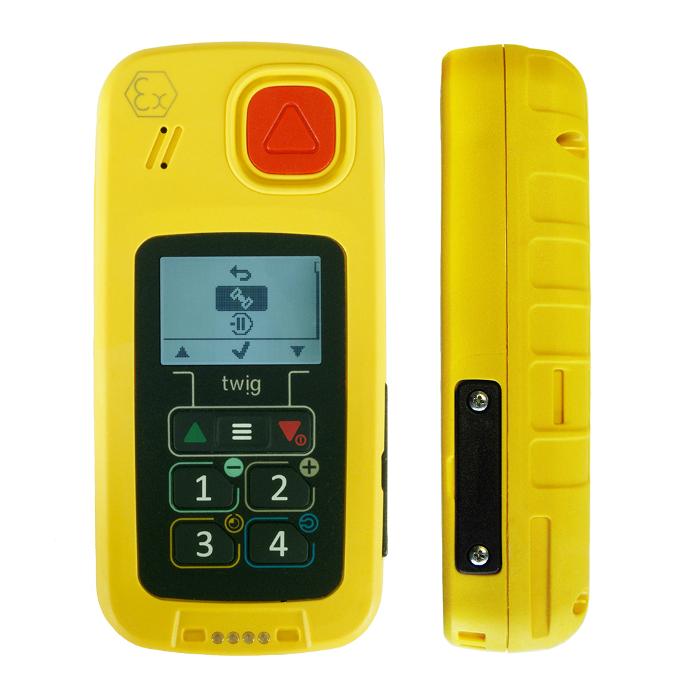
TWIG One-Ex – ATEX/IECEx-Certified Industrial Lone Worker Safety Device
Operation and technical details
Where is it used?
Evaluated in refineries, petrochemical plants, industrial gas facilities, power stations, OIZ maintenance units and operations where personnel using protective equipment work alone in explosive atmospheres.
Key safety features
Configuration-dependent SOS, fall/immobility and timer-based risk alarm, high-volume voice communication, GNSS positioning, Wi-Fi/Bluetooth/SRD-based indoor location support and TWIG Point / MPTP monitoring integration. Features more physical keys suitable for gloved operation.
ATEX / IECEx scope
Manufacturer-published marking: II 2 G Ex ib IIC T4 Gb and II 2 D Ex ib IIIC T130°C Db. Certified operating temperature −20°C to +60°C; protection rating IP67. The EESF 20 ATEX 045X / IECEx EESF 19.0020X certificate details documented by the manufacturer must be verified alongside the configuration.
Differences from the Neo-Ex model
One-Ex prioritises heavy industrial conditions, gloved operation and high-volume communication; furthermore, its IIIC dust marking differs from the IIIB marking of the Neo-Ex. Only approved accessories and the charging procedure in the manufacturer instructions must be used in Ex atmospheres. The device is not a direct gas measurement instrument.
TWIG One-Ex is a rugged, ATEX/IECEx-approved lone worker alarm with high-volume voice communication for personnel working with gloves/PPE in natural gas, petrochemical and heavy industrial sectors. It combines SOS, man-down, GNSS and 4G communication.
How to select the right safety system for lone workers?
Lone worker safety is not merely about device selection: emergency scenarios, communication coverage, who receives alarms, personnel location and emergency team response times must be planned in unison. The following topics may be evaluated on a facility basis.
OIZ, natural gas infrastructure and energy utilities
Personnel frequently work alone across OIZ maintenance, energy, electricity grid and natural gas pipeline operations. Automatic man-down alarms, SOS, location accuracy, shift monitoring and coverage scenarios take priority. If gas hazards are also present, the G7c sensor configuration can be evaluated separately.
Mobile network coverage, underground and indoor positioning
Cellular coverage and GNSS positioning should be tested separately in open-field conditions. Enclosed buildings, warehouses and plants may require Wi-Fi/Bluetooth/SRD beacons or other suitable positioning infrastructure. Satellite connectivity is not available on every device.
Man-down, SOS and alarm response plan
On most devices, man-down initiates an alarm sequence following a fall or period of immobility. However, for genuine protection, authorised recipients, escalation protocols, test intervals, false-alarm procedures and rapid assistance workflows must be defined.
ATEX / IECEx and personal gas detection
Explosive atmospheres require a model suited to the facility's zone classification along with current certification. TWIG One-Ex / Neo-Ex are evaluated separately from standard models. If personal gas measurement is required, it must be noted that not all alarm devices incorporate gas sensors.
ATEX/IECEx: TWIG Neo-Ex or TWIG One-Ex?
Both models feature II 2G Ex ib IIC T4 Gb marking for gas. Neo-Ex is lighter and offers varied carrying options including a wristband; its dust marking is IIIB and its certified temperature range is −20/+50°C. One-Ex is developed for heavy industry, high-volume alarms and gloved operation; its dust marking is IIIC and its certified temperature range is −20/+60°C. Site zone classification, dust/gas group and valid certification must be confirmed independently.
Frequently Asked Questions About Lone Worker Safety Systems
What is a lone worker safety system?
It is a wearable system that helps individuals working alone or out of sight of other workers be identified more rapidly in an emergency via SOS calls, immobility/fall alarms, location sharing and voice/data communication.
How does the man-down (immobility/fall) alarm work?
A configured automatic alarm sequence can trigger upon the device detecting immobility, falls or specific motion thresholds. Appropriate connectivity and monitoring infrastructure are required to transmit alarms and location data.
Does Blackline Safety G7c feature satellite connectivity?
No. G7c communicates with Blackline Live via cellular networks. Where satellite connectivity is required, the Blackline G7x and G7 Bridge architecture is evaluated separately.
What is the difference between TWIG One and TWIG Neo?
TWIG One is a robust option focused on functional keys for demanding and noisy industrial conditions. TWIG Neo highlights lightweight, compact and wearable use. Exact functions depend on hardware, licences and configuration.
Do lone worker devices determine location indoors?
Certain models can provide indoor location support using appropriate Wi-Fi, Bluetooth beacon or SRD infrastructure. It should not be assumed that satellite-based GNSS positioning alone will suffice inside buildings.
Do all of these devices perform gas measurement?
No. TWIG One and TWIG Neo are primarily developed for personal alarms, communication and location alerts. Blackline G7c provides gas detection options via fitted compatible gas sensor cartridges.
Which model should I select for areas requiring ATEX?
Selection is made based on current hazardous area classification and the actual Ex marking of the device in explosive gas/dust atmospheres. TWIG Neo-Ex (gas IIC, dust IIIB) and TWIG One-Ex (gas IIC, dust IIIC) are distinct ATEX/IECEx models. These certifications cannot be automatically attributed to standard TWIG Neo or TWIG One models.
Which features are important for OIZ or urban gas distribution teams?
Man-down and SOS workflows, mobile coverage, outdoor and indoor positioning, who receives alarms and how quickly, battery life, ATEX requirements, gas detection and integration with enterprise monitoring software should all be evaluated.
Do TWIG Neo-Ex and TWIG One-Ex measure gas leaks?
No. TWIG Neo-Ex and One-Ex are personal SOS, man-down, communication and location alarm systems certified for explosive atmospheres; they are not detectors that measure gas concentration. A suitable gas detector must be selected separately for measuring methane, CO, H₂S or oxygen.
What is the ATEX difference between TWIG Neo-Ex and TWIG One-Ex?
Both feature II 2G Ex ib IIC T4 Gb marking for gas atmospheres. For dust atmospheres, Neo-Ex is marked II 2D Ex ib IIIB T130°C Db, and One-Ex is marked II 2D Ex ib IIIC T130°C Db. Temperature ranges also differ: Neo-Ex −20/+50°C, One-Ex −20/+60°C. Suitability for the site must be confirmed against certificates and zone classifications.