
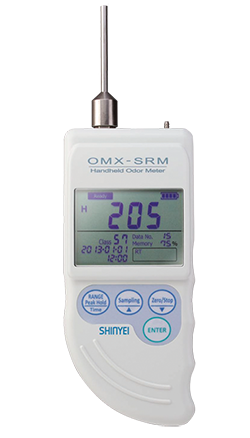
Shinyei OMX Series – Portable Odour Analysis and TVOC Measurement Instruments
Operation and technical details
Model selection: Three distinct measurement objectives
Designed for monitoring numerical odour intensity trends in field comparisons such as tobacco smoke, food, post-cleaning odours, process odours and similar applications.
Supports the evaluation of odour changes in environments such as wastewater, decomposing organic matter, pungent ammonia-related odours, hospitals and nursing homes.
Provides a toluene-equivalent digital readout for indoor air quality and volatile organic compounds. Does not separate individual chemical species with laboratory precision.
Field advantages and operating principle
Utilises two semiconductor gas sensors with an internal suction pump. The digital display, data logging and PC-based trend review functions assist in conducting reproducible field comparisons—for instance, across different points of a treatment plant, along food production lines, or before and after deodorisation treatments.
Current product description
Do not leave odour complaints solely to subjective assessment. The Shinyei OMX Series makes environmental surveys, process control and odour source investigations far more systematic with a portable analytical solution that helps rapidly compare odour and TVOC variations in the field.
Measurement limitations and compliance
OMX readout values are not directly equivalent to human odour perception; they must not be interpreted as European odour units (ouE/m³), as a verified ppm concentration of a specific gas, or as an accredited analytical result. The manufacturer explicitly states that the OMX family is not CE marked. For statutory odour emission measurements, reference methods such as EN 13725 dynamic olfactometry may be required depending on the scope of application.