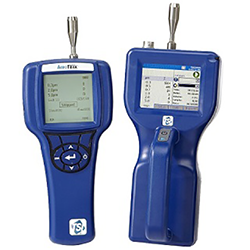
TSI AeroTrak™ 9303 and 9306 – Handheld Particle Counters
Handheld optical particle counter for spot checks and investigating particulate contamination in controlled environments.

NOVEL · Product family
Cleanroom particle counters help monitor particulate contamination in controlled environments. Compare size-channel counting, spot checks and complementary ultrafine particle monitoring.
Handheld optical particle counter for spot checks and investigating particulate contamination in controlled environments.
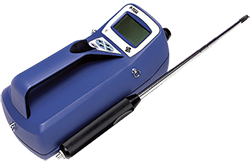
Portable counter for monitoring ultrafine particles when investigating air quality and potential aerosol sources.
The correct product family is selected by jointly defining the measurement purpose, site conditions, data requirements and the method to be used. The following sections explain selection and implementation planning for cleanroom particle counters.
Particle measurement in controlled environments is used for monitoring the area, investigating potential contamination sources and conducting assessments required by the sampling plan. Measuring points, particle size channels and sampling duration are determined according to the target study. A single spot measurement may not represent the continuous condition of the entire area.
Handheld instruments can be used for portable surveys across multiple points and routine spot checks. Continuous monitoring, by contrast, is engineered with fixed sampling locations, data transmission, logging and evaluation infrastructure. Product selection must be guided by measurement frequency, number of points and data management requirements.
Optical particle counting by size channels and ultrafine particle number concentration represent different measurement approaches. They can complement each other during source investigations in or around controlled spaces. The output produced by the instrument must align with the assessment method; different counter types should not automatically be substituted for one another.
The intended use of the area and the applied evaluation method determine the required size channels. Sampling points, sample volume, run time and operational state of the room must be planned together. Counter selection should not be based solely on portability or brand; it must be matched to data and reporting specifications.
The position of the sample inlet and the sample tubing form an integral part of the measurement setup. Manufacturer-approved accessories, cleaning and verification routines must be followed. Sample point ID and timestamp are logged with the records. Where continuous monitoring is required, communication, data storage and alarm infrastructure are planned separately.
A particle counter provides number concentration or size-segregated channel counts. A dust monitor is typically intended for monitoring aerosol mass concentration. The results represent entirely different physical quantities.
It is well-suited for portable area surveys, spot checks and investigating potential particle emission sources. Logging requirements and sampling plans should be established during selection.
Not for all assessments. Ultrafine particle monitoring and size-fractionated contamination classification can require different metrics. The appropriate instrument is selected according to the study objective.
The intended classification/use of the controlled space, required size channels, sampling locations, sample duration and data logging requirements must be specified. Any requirement for continuous monitoring should also be defined.
Standard optical particle counting does not differentiate viability or species. Microbiological assessment requires dedicated sampling and analytical procedures. In a controlled room monitoring programme, non-viable particle counting and microbiological monitoring serve distinct purposes.
Room classification requires an appropriate standard method, sampling grid and statistical evaluation. A single instrument or single-point reading does not automatically establish classification for the entire room. Number of sample locations, sampling conditions and report scope must be defined in line with the target standard.
They serve as complementary diagnostic tools for tracing ultrafine particle sources. It should not be assumed that they yield the same results as size-channel cleanroom counters. Required metrics, particle size range and instrument suitability for the target methodology must be verified separately.
A spot check is a measurement conducted at a specific point in time and place; continuous monitoring tracks temporal trends. They answer different operational questions. When comparing data, room operating state, location, engineering units and sampling parameters must be documented; brief spot measurements should not be interpreted as continuous logs.
NOVEL technical support
A draft opens in your email client with the subject header of the relevant product or category.